
Battery capacity C1,C10, and C20 explained
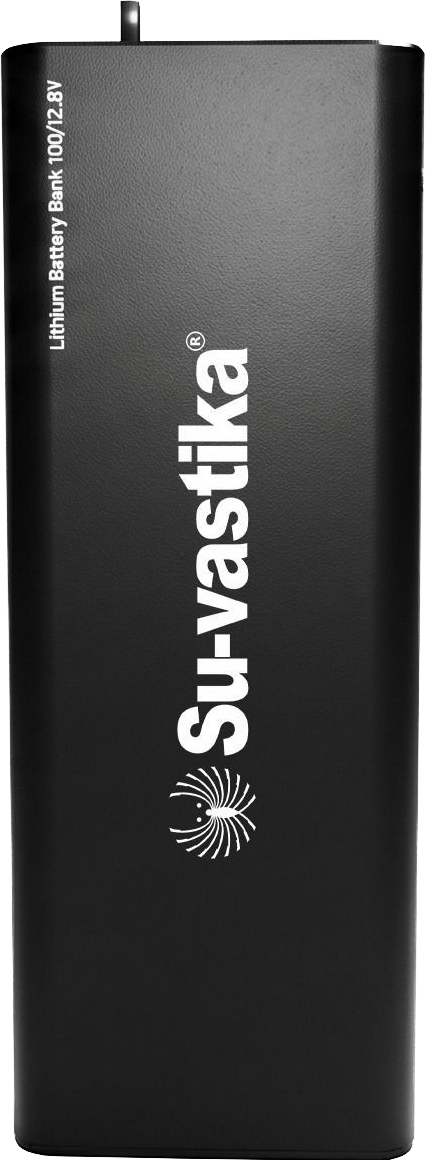
C1, C10 and C20 are battery C-ratings — they tell you how fast a battery is rated to discharge, and therefore how much usable capacity (Ah) you actually get. Choosing the right C-rating decides your real backup time. Here’s the simple explanation, with a side-by-side comparison and FAQs.
In battery technology, C1, C10 and C20 describe the discharge rate of a battery. The same battery gives different usable capacity depending on its C-rating, because capacity varies with the load applied. These ratings are crucial for understanding real performance in inverters, UPS, and solar systems.
What does the “C” in C-rating mean?
The “C” stands for Capacity. It represents the discharge rate relative to the battery’s total capacity. For a 150 Ah battery: a C1 rating means it delivers 150 A for 1 hour, C10 means 15 A for 10 hours, and C20 means 7.5 A for 20 hours.

C1 vs C10 vs C20 — side by side (150 Ah battery)
| C-rating | Discharge time | Current (150 Ah) | Typical battery / use |
|---|---|---|---|
| C1 | 1 hour | 150 A | Lithium batteries; EVs, high-power loads |
| C10 | 10 hours | 15 A | Solar, UPS & backup; tubular batteries |
| C20 | 20 hours | 7.5 A | Low-power, long-duration (emergency lighting) |
C1 (1-hour rate)
The most demanding rate, and largely theoretical for large lead-acid batteries — discharging high current at C1 needs careful terminal, wiring and heat design. Lithium batteries are rated at C1: a 150 Ah lithium battery can deliver close to its full 150 Ah even at a 150 A discharge. Best for high-power applications where energy is needed quickly.
C10 (10-hour rate)
A moderate rate — the battery discharges fully over 10 hours (15 A for a 150 Ah battery). C10 is the standard rating for solar, UPS and backup power, and most quality tubular batteries are rated at C10.
C20 (20-hour rate)
The least demanding rate — full discharge over 20 hours (7.5 A for a 150 Ah battery). C20 inflates the headline Ah number, which is why many cheaper batteries quote C20. Best for low-power, long-duration loads like emergency lighting. To size a system properly, see how to calculate backup time.
Why this matters when buying: a “150 Ah” battery quoted at C20 will give noticeably less backup at the faster C10 rate that inverters actually run. Always compare batteries at the same C-rating — ideally C10 for inverter/UPS use — or choose a C1-rated lithium battery for full usable capacity.
Why real backup time depends on your load
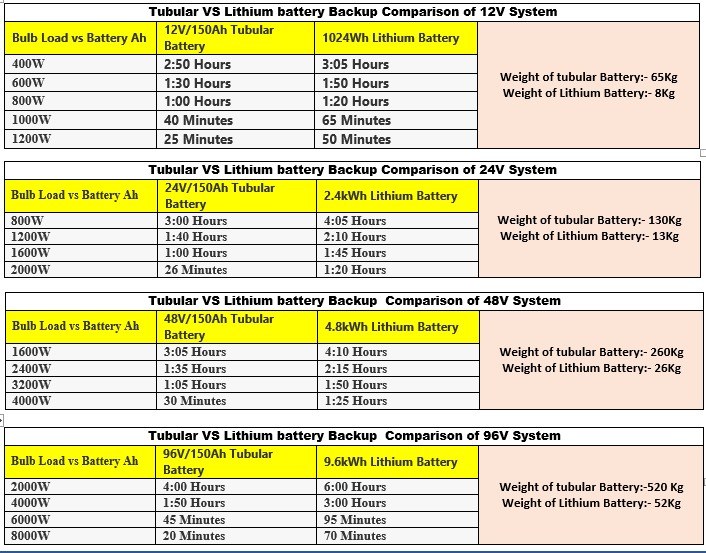
Here’s what most battery sellers don’t tell you: most lead-acid batteries sold in the market don’t disclose their C-rating, and almost none ship with a chart showing backup time at different loads. Yet as the load increases, the backup time falls sharply — and not in a straight line. A 150 Ah tubular battery performs well on a light 200–300 W load, but at 500 W the backup time drops noticeably, and at 1000 W it becomes too low to be useful. This is the Peukert effect: lead-acid batteries lose effective capacity at higher discharge currents. It is exactly why the C-rating — and the actual load you run — matters far more than the headline Ah number, and why a C1-rated lithium battery, which holds its capacity even at high loads, delivers much more usable backup. The chart below compares real backup time for tubular vs lithium batteries across 12V, 24V, 48V and 96V systems at different loads.
Which C-rating should you choose?
- Inverter / UPS / solar backup: choose C10 (lead-acid/tubular) for honest, usable capacity.
- Maximum usable capacity & fast charge/discharge: choose a C1-rated lithium battery.
- Long, low-current loads only: a C20 battery can suffice, but compare carefully.
Frequently asked questions
Related Su-vastika guides
- What C-rating means for a home inverter/UPS
- Difference between C20 and C10 tubular battery
- Unveiling the secrets of C-rating in batteries
- How to calculate backup time in a tubular battery inverter
- Difference between tubular and lithium battery
Su-vastika in the news: Su-vastika launches a 1S-to-48S Wireless Handheld Cell Voltage Tester · Business Standard: 500 KVA Lithium Battery UPS, an alternative to diesel generators.

⚡ Calculate your exact backup time — free
Our mentor Kunwer Sachdev designed a free calculator for the ease of selection of battery and inverter, with the exact backup time chart — built on real lab discharge tests, not brochure mathematics. Try the backup calculator on InverterIndia.com →
From Kunwer Sachdev’s Network
Want to compare prices before you buy?
India’s independent price-comparison and buying-intelligence hub for inverters, batteries and solar — zero affiliate bias.
➤ Compare inverter & UPS prices
➤ Lithium vs lead-acid — full guide
➤ Free backup calculator (lab-tested data)
The story of Kunwer Sachdev — 76+ patents, India’s first plastic-body inverter, and the journey that brought solar into millions of homes.
➤ Pioneer timeline of firsts
➤ Video library — the work in his own voice
Disclaimer: This article is written by Kunwer Sachdev, mentor of Su-vastika. Kunwer Sachdev is no longer associated with Su-Kam Power Systems Ltd. in any capacity. Anyone dealing with Su-Kam should be aware that Kunwer Sachdev has no association with the Su-Kam brand or company.
Part of the Series
Complete Guide to Lithium Batteries for Home Inverters in IndiaExplore Products
Su-vastika Lithium Batteries
25+ patents · Made in India · 10,000+ installations