
C10 vs C20 Tubular Battery: the Specs Con, the Blast Risk & How to Test It
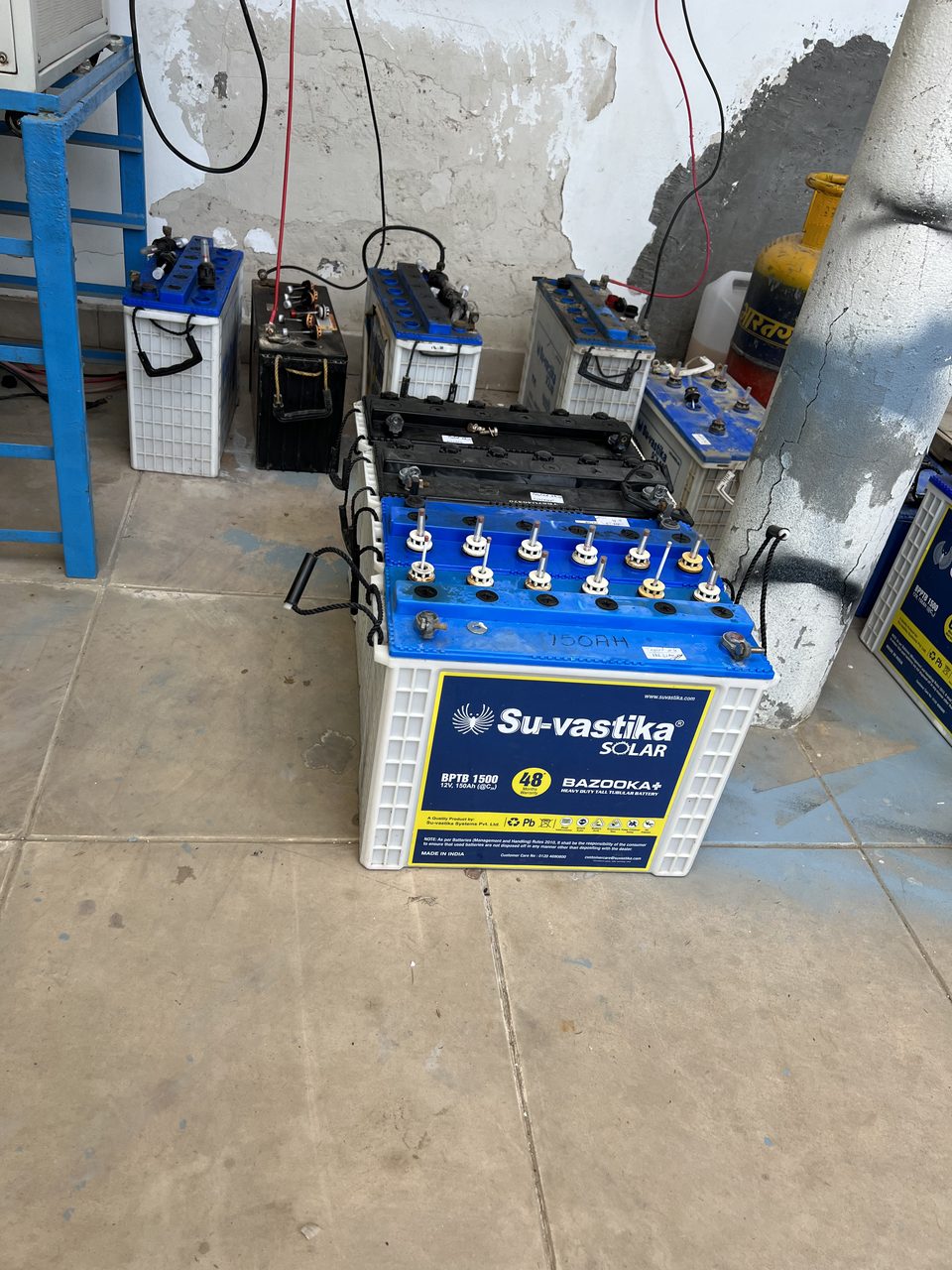
C10 vs C20 in a tubular battery is the most misunderstood spec in the inverter industry. The C-rating is the battery’s discharge rate, not “solar vs inverter.” This guide clears the myth, gives you a 5-minute showroom test to check if a battery is really C10 or C20, and shows where lithium (C1) fits.
Note: Su-vastika has discontinued manufacturing lead-acid (tubular) batteries and now focuses entirely on lithium (LiFePO4) battery storage.
There’s a rumour across the inverter and solar trade that a C20 battery is for inverters/UPS and a C10 battery is for solar. That is wrong. The whole industry talks about C-rating as if it were charging speed and can’t explain it properly. In reality, C10 and C20 describe how fast the battery is rated to discharge — and therefore how much usable capacity you actually get.
What C10 and C20 actually mean
For a 150 Ah battery: at C20 the maker claims it gives 20 hours of backup at a 7.5 A draw (150 ÷ 20). At C10 it should give 10 hours at a 15 A draw. But here’s the catch — draw 7.5 A from a tubular battery today and you rarely get a true 20 hours, once you account for inverter efficiency. So the headline Ah figure on the label means very little until you test it.
| Rating | Discharge basis (150 Ah) | Real usable capacity | Price |
|---|---|---|---|
| C20 | 7.5 A for 20 hrs | Lowest — inflated headline Ah | Base price |
| C10 | 15 A for 10 hrs | Higher than C20 | ~15–20% more |
| Lithium (C1) | 150 A for 1 hr | Full capacity at any load | ~50% more, ~4× the life |
The real-load reality: why ratings collapse
A real home runs far higher loads than 7.5 A. A 500-watt load on a 12 V inverter draws about 42 A (500 ÷ 12). No company tells you the backup at 42 A — whether the battery is C20 or C10 — because at that current a tubular battery loses a large part of its rated capacity. That is exactly why the C-rating, and the actual load you run, matters far more than the Ah number on the sticker.
The real con: a C-rating with no actual specs
Printing just “C10” or “C20” on a battery tells you almost nothing. An honest battery should come with a charging-time graph, a discharge graph at different loads, and a backup-time chart at different loads — yet almost no tubular maker provides any of these. A single letter-and-number hides everything that actually decides performance. The “one is for solar, one is for inverter” story is part of the same con: it distracts buyers from the one thing that really matters — the safe charge rate the battery can take.
The dangerous truth: fast solar charging can blow up a tubular battery
A tubular lead-acid battery must be charged slowly. Charge it too fast — exactly what many high-current solar chargers do — and the electrolyte (water and acid) overheats and evaporates, pressure builds, and the battery can swell, leak acid, or explode like a bomb, throwing lead and plastic shrapnel.
Industry experience shows a large share of tubular battery failures and blasts come from high-rate solar charging — and every failed battery is repeat business for the seller. This is the real reason the “solar battery vs inverter battery” label is dangerous: it hides the charge-rate limit instead of warning you about it.
Real incidents are well documented: four members of a Delhi family died in an inverter-battery explosion, with similar blasts reported across Uttar Pradesh. This is why Su-vastika designs slow, staged, temperature-compensated charging — see our guide to inverter/UPS charging, ATC & battery life, and our awareness posts on tubular lead-acid battery explosions in India and how to safeguard against tubular/SMF battery explosions.
Published in the public interest. The deaths and blasts that reach the news are only the visible tip. Search YouTube and Facebook and you’ll find countless users showing swollen, leaking and burst inverter and tubular batteries — far more than the few cases the media reports, and many such complaints get quietly buried. Yet almost no manufacturer prints a charge-rate warning or educates buyers about safe charging. Worse, no one keeps proper data on these incidents — neither the companies nor any government body — so the official count stays tiny while the real number, visible all over social media, keeps climbing year after year, even long after the few cases that did make the news. That silence is exactly why these incidents keep rising. This guide is shared so you can protect your home and family — not to sell you anything.
Test it yourself in 5 minutes (the thumb rule)
How to check if a 150 Ah tubular battery is genuinely C10 or C20 — right at the showroom:
- Take any inverter/UPS that can hold a 1200 W load on a single 150 Ah battery.
- Fully charge the battery.
- Connect a 1200 W load — six 200 W bulbs.
- Time the backup: more than 30 minutes → genuine C10; less than 25 minutes → not even a true C20.
The whole test takes about 25 minutes. Repeat it after two years of use to see how much real backup is left — the honest measure of battery quality.
Where lithium (C1) changes everything
A lithium (LiFePO4) battery is rated at C1 — it can deliver close to its full Ah even at high loads, so the capacity doesn’t collapse the way tubular does. That’s the core difference: for higher loads, lithium is really the only honest solution, and it lasts about four times longer than tubular lead-acid. See the difference between tubular and lithium battery and C1, C10 & C20 capacity explained for the full picture.
So which is cheaper — C10, C20 or lithium?
A C10 tubular costs about 15–20% more than C20, and a lithium battery costs roughly 50% more than a C20 tubular — but with about 4× the life, lithium is cheaper per year of service. With lithium prices now close to tubular levels, that gap has narrowed further — see lithium battery prices in India and why lithium is cheaper than tubular.
Frequently asked questions
Skip the C10-vs-C20 guesswork — move to a C1-rated lithium battery.
See Su-vastika lithium batteries Talk to usRelated Su-vastika guides
- C1, C10 & C20 battery capacity explained
- Difference between tubular and lithium battery
- 12 V tubular battery inverter system — pros & cons
- Lithium battery prices in India
Reference: Natural Energy Hub — differences between C10 & C20 rated batteries. Also in the public interest: Top 6 EV scooter brands in India 2026 — sales vs complaints, by Kunwer Sachdev (lithiuminverter.in).

⚡ Calculate your exact backup time — free
Our mentor Kunwer Sachdev designed a free calculator for the ease of selection of battery and inverter, with the exact backup time chart — built on real lab discharge tests, not brochure mathematics. Try the backup calculator on InverterIndia.com →
From Kunwer Sachdev’s Network
Want to compare prices before you buy?
India’s independent price-comparison and buying-intelligence hub for inverters, batteries and solar — zero affiliate bias.
➤ Compare inverter & UPS prices
➤ Lithium vs lead-acid — full guide
➤ Free backup calculator (lab-tested data)
The story of Kunwer Sachdev — 76+ patents, India’s first plastic-body inverter, and the journey that brought solar into millions of homes.
➤ Pioneer timeline of firsts
➤ Video library — the work in his own voice
Part of the Series
Complete Guide to Lithium Batteries for Home Inverters in IndiaExplore Products
Su-vastika Lithium Batteries
25+ patents · Made in India · 10,000+ installations