
Difference Between MPPT and PWM Solar Charge Controller — and Why India Still Buys the Wrong One
A confession from the Inverter Man of India. For more than a decade — first at Su-Kam, now as mentor at Su-vastika — I have tried my level best to make people understand the difference between MPPT and PWM solar charge controllers. We made videos that collected lakhs of views, ran live bench tests, trained thousands of dealers. And yet today, PWM controllers still sell in huge numbers across India and Africa — because the customer doesn't know, and too many dealers don't care. Let me try once more.
The Difference in One Paragraph
A solar panel has one operating point where it delivers maximum power — and that point moves all day with sunlight and temperature. A PWM (Pulse Width Modulation) controller charges the battery by switching the current on and off at high frequency — simple and cheap, but it drags the panel down to battery voltage, so wherever the maximum power point happens to be, it is lost. An MPPT (Maximum Power Point Tracking) controller is an electronic system that constantly adjusts voltage and current so the panel always operates at its maximum power point, then converts that power to exactly what the battery needs. (Background: charge controller — Wikipedia.)

The MPPT vs PWM explainer we made in my Su-Kam days — the message is a decade old and still not understood
We Proved It on the Bench — You Can Too
In our R&D days we proved this on the test bench: from the very same panel, in the same sunlight, the MPPT delivered roughly one-third more power into the battery than the PWM. That third of the customer's solar investment was simply evaporating inside the cheaper controller.
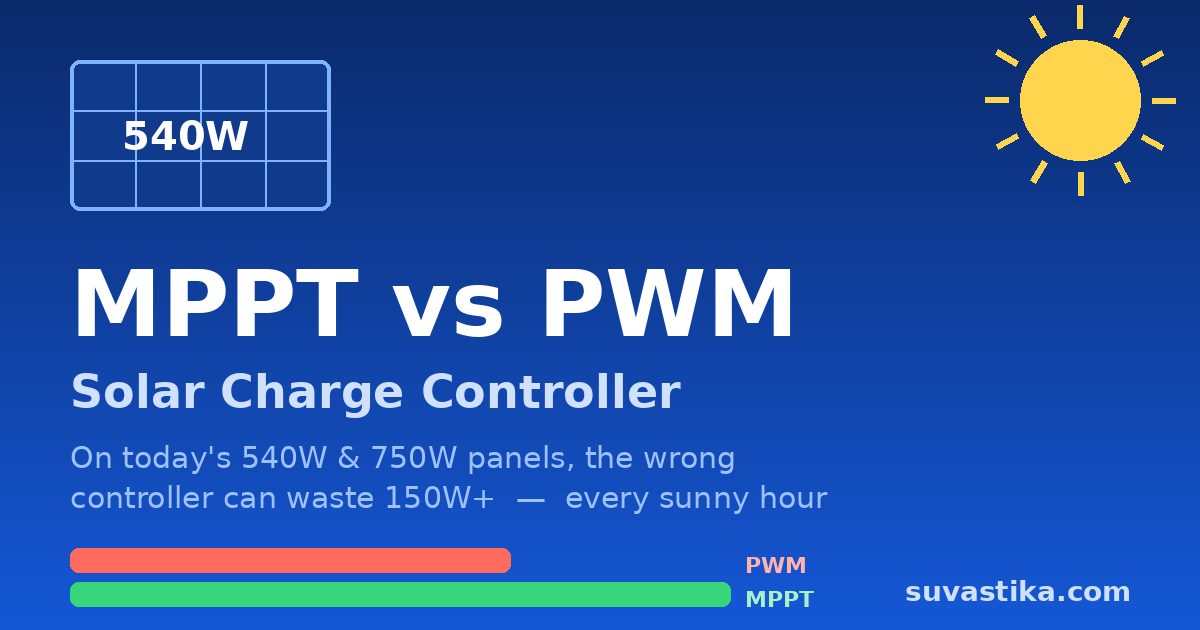
Now apply that to today's panels. A modern 540W panel on a PWM controller can waste 150W or more, and a 750W panel well over 200W — every sunny hour — because these panels run at ~38–48V, far above a 12V or 24V battery bank, and PWM throws that entire voltage difference away. The test method is simple, and I encourage every serious buyer and dealer to repeat it:
- Take one panel, one battery, two controllers (PWM and MPPT).
- Same sunlight, same connections. Measure voltage × current going into the battery through each controller.
- Compare. The meter doesn't lie — marketing does.
Our MPPT explainer — 1.9 lakh views, and the question still comes every week
MPPT vs PWM: The Honest Comparison
| Parameter | PWM | MPPT |
|---|---|---|
| How it charges | High-frequency on/off switching at battery voltage | Tracks the maximum power point, converts to battery voltage |
| Power harvested | Loses heavily when panel and battery voltages differ | Up to ~30% more — on a 540W panel that is 150W+ recovered |
| Voltage range | Narrow — panel must roughly match battery | Wide PV window — works with high-voltage strings |
| Today's 550–750W panels | Effectively unusable — massive voltage mismatch | Designed for them |
| Panels needed for same output | More (we showed 5 panels on PWM) | Fewer (≈3 panels do the same job) |
| Controller price | Cheaper upfront | Costlier upfront, cheaper per unit of energy delivered |
| Honest use case | Tiny 12V systems with old 36-cell panels | Everything else — homes, shops, offices, farms |
For a deeper dive into each technology, read what is an MPPT solar charge controller and what is a PWM solar charge controller.
What a Good MPPT Controller Must Have
Tracking is only half the job — charging discipline is the other half. Insist on these features (we built every one of them into our designs):
- Four-stage battery charging — Bulk, Absorption, Float and Equalization — so the battery is charged fast, finished gently and kept healthy.
- ATC (Automatic Temperature Compensation) — the correct charging voltage of a battery shifts with temperature; ATC senses ambient temperature and adjusts charging automatically. In our field data this alone extended battery life by about six months.
- Full protection suite: reverse battery connection, surge protection, ambient and heat-sink temperature compensation, reverse battery current flow (night-time) protection, PV high-current protection, and overload/short-circuit protection.
Why Does PWM Still Sell, Then?
I have thought about this failure honestly, because it is partly mine. Three reasons:
- The price tag wins the shop conversation. A PWM box is visibly cheaper. The 30% of solar generation it wastes is invisible — it disappears quietly, every day, for ten years.
- Dealer incentives. Many dealers stock what gives margin and moves fast. Very few will set up two controllers and a meter to show a customer the difference — even though that demonstration sells the better product instantly.
- "Solar is solar" thinking. The customer sees panels on the roof and assumes the job is done. Nobody told them the small box between the panel and the battery decides how much of that roof actually works.
The appetite to learn exists — our educational videos collected lakhs of views. The retail counter is where the knowledge dies.
Watching a real MPPT track the power point — the demonstration every dealer should give
How Not to Get Cheated: My Buyer's Checklist
- Ask which technology the controller uses. If the answer is vague — "fully automatic solar charging" — assume PWM.
- Ask for the MPPT voltage window and check your panel string's VOC sits inside it (my rule: VOC = 1.4–1.8 × battery voltage — full method here).
- Size the controller and battery together — see my guide on sizing the battery and solar charge controller.
- Ask for the demonstration. Any dealer with both products and a clamp meter can show you watts-into-battery in five minutes.
- Count the system cost, not the box cost. MPPT saves you panels, roof space and years of wasted generation.
- Prefer BIS-certified equipment — Su-vastika's hybrid solar PCU range with built-in MPPT is BIS certified.
Where the Technology Stands Today
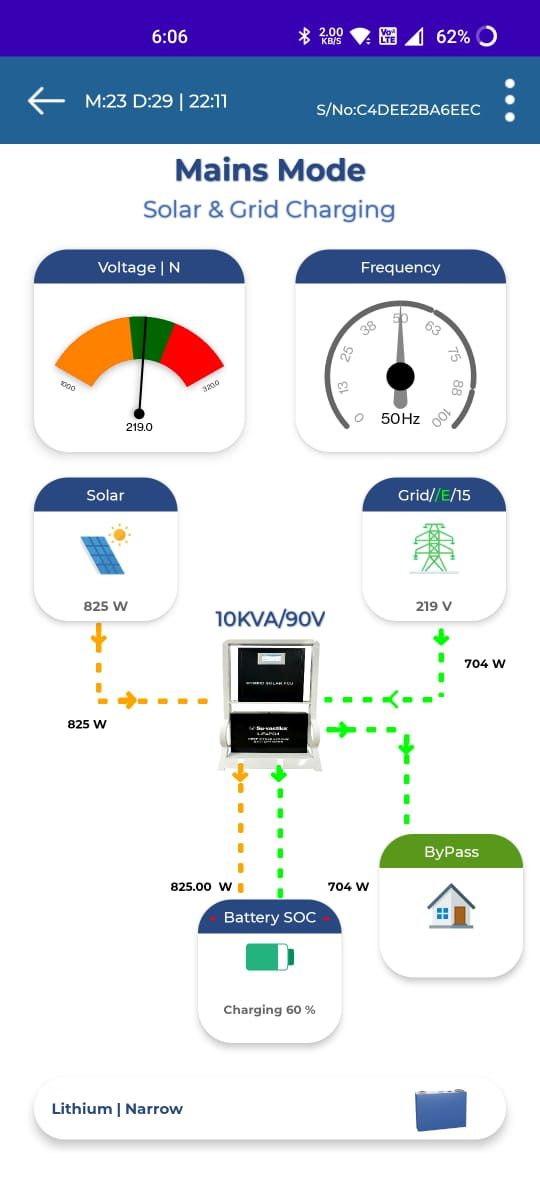
At Su-vastika, the MPPT charge controller no longer lives in a separate box — it is integrated into the solar hybrid PCU's internal circuitry along with solar-grid charging current sharing, lithium battery support and Bluetooth/Wi-Fi app monitoring. India's storage-backed solar market is finally exploding — pv magazine India documents these systems replacing diesel generators nationwide. The technology arrived. Now the awareness has to.
The modern answer: Su-vastika's 10kVA MPPT PCU with lithium battery running 4 ACs at night
Frequently Asked Questions
Q. Is PWM ever the right choice?
Only for very small 12V systems using old-style 36-cell panels whose voltage naturally matches the battery. For anything using today's 550–750W panels, PWM throws away a large share of your generation.
Q. How much more does MPPT really harvest?
Roughly a third more, measured on our own bench. On today's 540W panel that means 150W+ of extra power; on a 750W panel, over 200W — from the same roof.
Q. How do I check if my existing controller is PWM?
Watch the panel voltage while charging: if it gets dragged down to near battery voltage, it's PWM. An MPPT holds the panel near its Vmp (e.g. ~41V on a 550W panel) while charging a 24V battery.
Q. What features should a good MPPT controller have?
Four-stage charging (Bulk/Absorption/Float/Equalization), ATC temperature compensation, and full protections — reverse battery, surge, night-time reverse current, PV high current, overload and short circuit.
Don't let the cheapest box waste your roof
Su-vastika's BIS-certified solar hybrid PCUs come with true MPPT charging, lithium support and app monitoring.
Explore Products Talk to an ExpertRelated guides

From Kunwer Sachdev’s Network
Want to compare prices before you buy?
India’s independent price-comparison and buying-intelligence hub for inverters, batteries and solar — zero affiliate bias.
➤ Compare inverter & UPS prices
➤ Lithium vs lead-acid — full guide
➤ Free backup calculator (lab-tested data)
The story of Kunwer Sachdev — 76+ patents, India’s first plastic-body inverter, and the journey that brought solar into millions of homes.
➤ Pioneer timeline of firsts
➤ Video library — the work in his own voice
Disclaimer: This article is written by Kunwer Sachdev, mentor of Su-vastika. Kunwer Sachdev is no longer associated with Su-Kam Power Systems Ltd. in any capacity. The older videos referenced were created during his tenure at Su-Kam and remain on the Su-Kam Solar YouTube channel. Anyone dealing with Su-Kam should be aware that Kunwer Sachdev has no association with the Su-Kam brand or company.
Part of the Series
Solar PCU & MPPT Charge Controllers: Complete GuideExplore Products
Su-vastika Solar PCU
25+ patents · Made in India · 10,000+ installations